
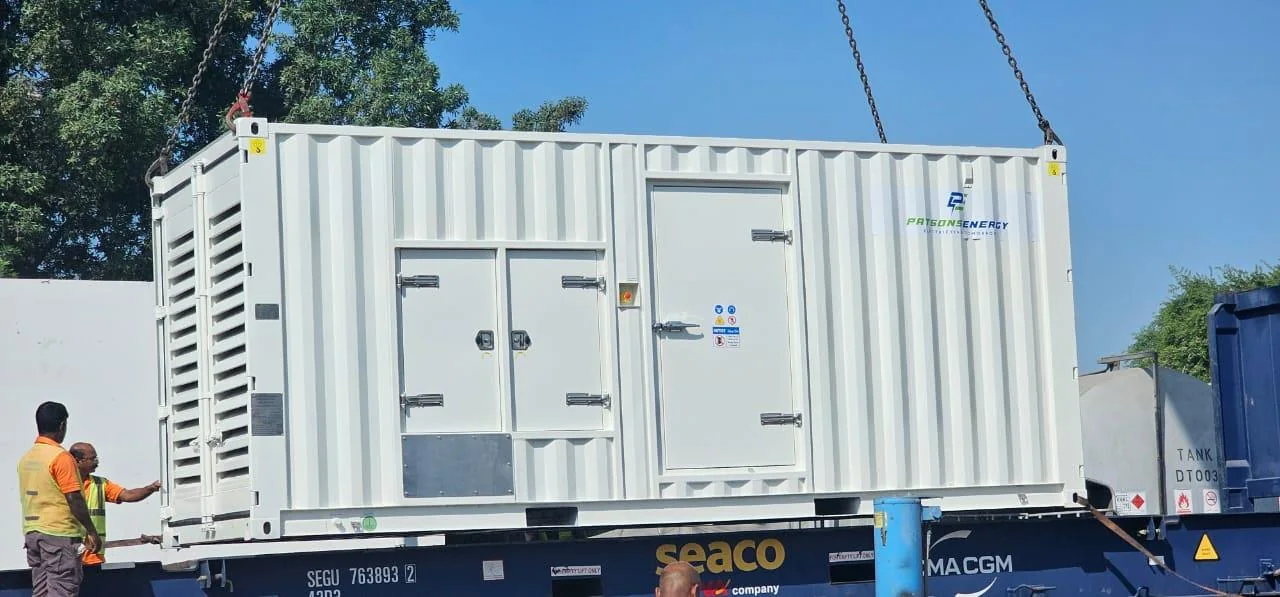
Containerized power
Containerized generator systems built around the site.
We bring the generator, airflow, acoustic treatment, exhaust, fuel, controls and maintenance access together inside one transportable enclosure.
Integrated scope
Resolve the connections before the container reaches site
Cable routes, fuel connections, airflow and maintenance access are much easier to solve during design than after delivery. We coordinate each one around the selected generator and site.
Cooling & ventilation
Air intake, discharge, attenuation, weather protection and recirculation control.
Fuel system
Base or day-tank arrangement, fill, vent, drain, leak containment and external connections.
Exhaust system
Silencer selection, supports, expansion, insulation, outlet position and back-pressure control.
Electrical interfaces
Power cable route, gland plates, control wiring, auxiliary supply and earthing points.
Controls
Local generator control, emergency stop, remote signals, synchronization and monitoring interfaces.
Access & handling
Personnel doors, removable panels, lifting details, transport bracing and major-component replacement path.
Critical power
Leave enough room to maintain the equipment
Large generator packages need room for routine checks and a credible path for radiator, alternator or engine work. Access that looks adequate on a drawing can fail once exhaust, cable trays and attenuation are added.
Patsons reviews operating and maintenance zones during layout development. The project team can then confirm access before fabrication, reducing the chance of expensive site modifications.
Site coordination
Details to close before fabrication begins
- Foundation loads, plinth dimensions and vibration-isolation strategy
- Transport route, lifting plan and final equipment orientation
- Fresh-air source and hot-air discharge clearance
- Fuel supply, return, vent and spill-containment responsibilities
- Power and control cable routing, bend radius and termination space
- Fire detection, suppression and life-safety interfaces where specified
- Remote monitoring, BMS or SCADA signal schedule
- Factory and site acceptance test boundaries
Frequently asked questions
Common questions
Can’t find what you need? Send us your requirement and our team will help.
What is included in a containerized generator system?
The agreed scope can include the generator, structural container, acoustic treatment, ventilation, exhaust, fuel system, lighting, auxiliaries, controls, cable interfaces and safety provisions. Each item is confirmed in the technical offer.
Can multiple containerized generators run in parallel?
Yes. Multi-set systems can be developed with synchronization and load sharing, subject to the required control philosophy, switchgear architecture, redundancy and site network.
Are standard shipping containers always suitable?
Not always. Generator airflow, noise, access, structural loading and equipment replacement paths may require a purpose-built or substantially modified container. The format should follow the engineering requirement.
Can Patsons support data-center or industrial critical power projects?
Patsons can develop large, redundant and multi-set packages. The project team should provide the duty, load steps, redundancy basis, site interfaces, controls and testing protocol for review.