
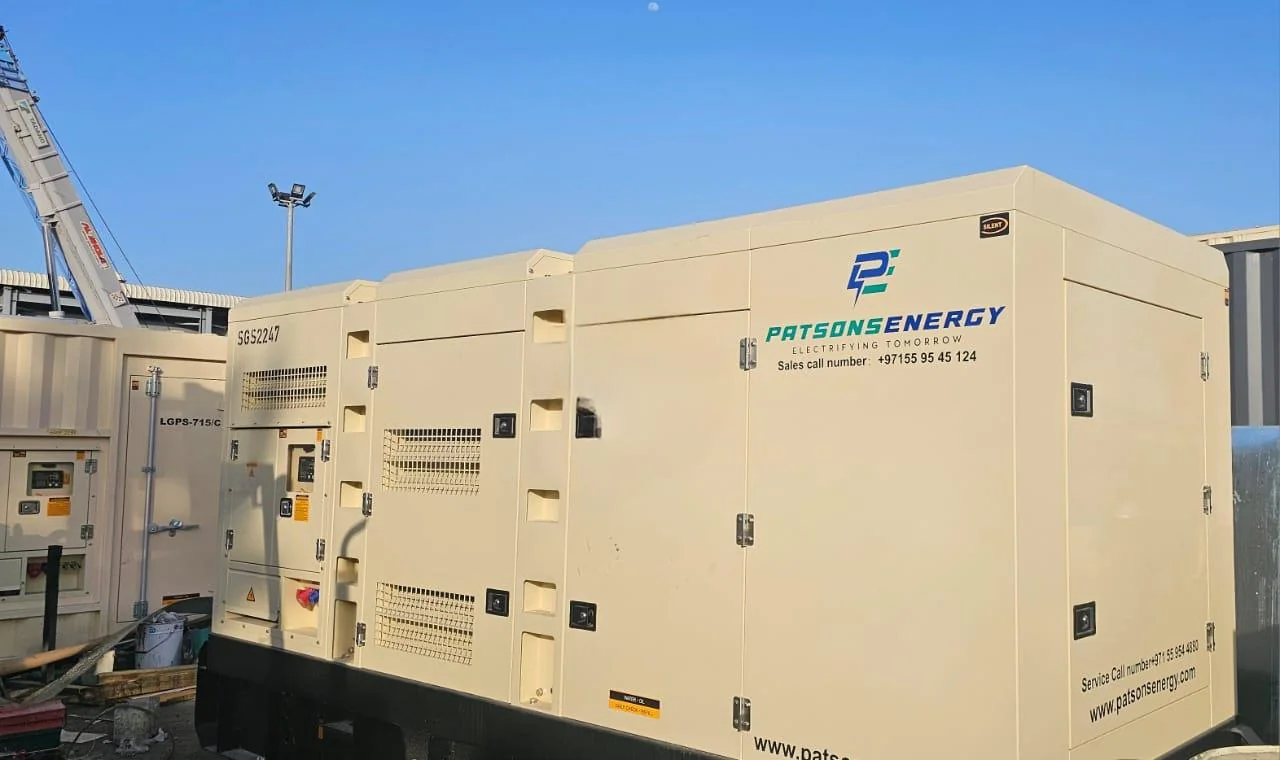
Diesel generators UAE
Diesel generators built for prime and standby power.
We engineer and assemble generator systems from 100 to 3,000 kVA at our Dubai facility. Every build starts with the load, duty, site conditions and the way the equipment needs to operate.
Configuration
The engine and alternator are only the starting point
Airflow, fuel autonomy, controls, noise, transport and service access all affect how the finished generator performs on site.
Open generator sets
Skid-mounted packages for dedicated plant rooms, protected industrial spaces and projects where the building provides the enclosure.
Sound-attenuated sets
Weather-protected acoustic canopies with service doors, ventilation paths and silencing selected around the site noise target.
ExploreContainerized systems
Large packaged systems with integrated ventilation, exhaust, fuel, control and maintenance provisions for critical installations.
ExploreTransportable packages
Trolley-mounted or project-specific transportable sets for changing work fronts and temporary operating locations.
Engineering power matrix
Diesel generator power ratings and technical specifications
Standard ratings from 100 to 3,000 kVA configured for UAE 50 Hz (380–415V) and 60 Hz (380–480V) applications, with high-ambient desert cooling and custom acoustic canopies.
Swipe horizontally to view all columns
| Standard rating | Prime output | Standby output | Typical fuel (75% prime) | Sound attenuation (Canopy) | Standard controller |
|---|---|---|---|---|---|
| 100 kVA / 80 kW | 100 kVA (80 kWe) | 110 kVA (88 kWe) | 16–20 L/h | 68–72 dBA @ 7m | DSE 6120 / Auto-Mains Failure |
| 150 kVA / 120 kW | 150 kVA (120 kWe) | 165 kVA (132 kWe) | 24–30 L/h | 70–73 dBA @ 7m | DSE 6120 / Auto-Mains Failure |
| 200 kVA / 160 kW | 200 kVA (160 kWe) | 220 kVA (176 kWe) | 32–40 L/h | 70–74 dBA @ 7m | DSE 6120 / Auto-Mains Failure |
| 250 kVA / 200 kW | 250 kVA (200 kWe) | 275 kVA (220 kWe) | 40–50 L/h | 72–75 dBA @ 7m | DSE 7320 MKII / Dual ATS |
| 350 kVA / 280 kW | 350 kVA (280 kWe) | 385 kVA (308 kWe) | 54–68 L/h | 72–76 dBA @ 7m | DSE 7320 MKII / Modbus BMS |
| 500 kVA / 400 kW | 500 kVA (400 kWe) | 550 kVA (440 kWe) | 78–98 L/h | 73–77 dBA @ 7m | DSE 7320 MKII / Modbus BMS |
| 650 kVA / 520 kW | 650 kVA (520 kWe) | 715 kVA (572 kWe) | 100–128 L/h | 74–78 dBA @ 7m | DSE 7320 / DSE 8610 Ready |
| 750 kVA / 600 kW | 750 kVA (600 kWe) | 825 kVA (660 kWe) | 118–150 L/h | 75–79 dBA @ 7m | DSE 8610 Paralleling Controller |
| 1,000 kVA / 800 kW | 1,000 kVA (800 kWe) | 1,100 kVA (880 kWe) | 155–200 L/h | 75 dBA @ 7m (Drop-over) | DSE 8610 Multi-Set Synchronizing |
| 1,250 kVA / 1,000 kW | 1,250 kVA (1,000 kWe) | 1,375 kVA (1,100 kWe) | 195–250 L/h | 75 dBA @ 7m (Drop-over) | DSE 8610 Multi-Set Synchronizing |
| 1,500 kVA / 1,200 kW | 1,500 kVA (1,200 kWe) | 1,650 kVA (1,320 kWe) | 235–300 L/h | Custom acoustic enclosure | DSE 8610 Auto Load-Sharing |
| 2,000 kVA / 1,600 kW | 2,000 kVA (1,600 kWe) | 2,200 kVA (1,760 kWe) | 310–400 L/h | 20ft/40ft ISO CSC Container | DSE 8610 / ComAp InteliGen |
| 2,500 kVA / 2,000 kW | 2,500 kVA (2,000 kWe) | 2,750 kVA (2,200 kWe) | 390–500 L/h | 40ft ISO High-Cube Container | DSE 8610 / ComAp InteliGen |
| 3,000 kVA / 2,400 kW | 2,700 kVA (2,160 kWe) | 3,000 kVA (2,400 kWe) | 450–590 L/h | 40ft ISO Custom Acoustic Package | DSE 8610 Multi-Gen Paralleling |
-
100 kVA / 80 kW
- Prime output
- 100 kVA (80 kWe)
- Standby output
- 110 kVA (88 kWe)
- Typical fuel (75% prime)
- 16–20 L/h
- Sound attenuation (Canopy)
- 68–72 dBA @ 7m
- Standard controller
- DSE 6120 / Auto-Mains Failure
-
150 kVA / 120 kW
- Prime output
- 150 kVA (120 kWe)
- Standby output
- 165 kVA (132 kWe)
- Typical fuel (75% prime)
- 24–30 L/h
- Sound attenuation (Canopy)
- 70–73 dBA @ 7m
- Standard controller
- DSE 6120 / Auto-Mains Failure
-
200 kVA / 160 kW
- Prime output
- 200 kVA (160 kWe)
- Standby output
- 220 kVA (176 kWe)
- Typical fuel (75% prime)
- 32–40 L/h
- Sound attenuation (Canopy)
- 70–74 dBA @ 7m
- Standard controller
- DSE 6120 / Auto-Mains Failure
-
250 kVA / 200 kW
- Prime output
- 250 kVA (200 kWe)
- Standby output
- 275 kVA (220 kWe)
- Typical fuel (75% prime)
- 40–50 L/h
- Sound attenuation (Canopy)
- 72–75 dBA @ 7m
- Standard controller
- DSE 7320 MKII / Dual ATS
-
350 kVA / 280 kW
- Prime output
- 350 kVA (280 kWe)
- Standby output
- 385 kVA (308 kWe)
- Typical fuel (75% prime)
- 54–68 L/h
- Sound attenuation (Canopy)
- 72–76 dBA @ 7m
- Standard controller
- DSE 7320 MKII / Modbus BMS
-
500 kVA / 400 kW
- Prime output
- 500 kVA (400 kWe)
- Standby output
- 550 kVA (440 kWe)
- Typical fuel (75% prime)
- 78–98 L/h
- Sound attenuation (Canopy)
- 73–77 dBA @ 7m
- Standard controller
- DSE 7320 MKII / Modbus BMS
-
650 kVA / 520 kW
- Prime output
- 650 kVA (520 kWe)
- Standby output
- 715 kVA (572 kWe)
- Typical fuel (75% prime)
- 100–128 L/h
- Sound attenuation (Canopy)
- 74–78 dBA @ 7m
- Standard controller
- DSE 7320 / DSE 8610 Ready
-
750 kVA / 600 kW
- Prime output
- 750 kVA (600 kWe)
- Standby output
- 825 kVA (660 kWe)
- Typical fuel (75% prime)
- 118–150 L/h
- Sound attenuation (Canopy)
- 75–79 dBA @ 7m
- Standard controller
- DSE 8610 Paralleling Controller
-
1,000 kVA / 800 kW
- Prime output
- 1,000 kVA (800 kWe)
- Standby output
- 1,100 kVA (880 kWe)
- Typical fuel (75% prime)
- 155–200 L/h
- Sound attenuation (Canopy)
- 75 dBA @ 7m (Drop-over)
- Standard controller
- DSE 8610 Multi-Set Synchronizing
-
1,250 kVA / 1,000 kW
- Prime output
- 1,250 kVA (1,000 kWe)
- Standby output
- 1,375 kVA (1,100 kWe)
- Typical fuel (75% prime)
- 195–250 L/h
- Sound attenuation (Canopy)
- 75 dBA @ 7m (Drop-over)
- Standard controller
- DSE 8610 Multi-Set Synchronizing
-
1,500 kVA / 1,200 kW
- Prime output
- 1,500 kVA (1,200 kWe)
- Standby output
- 1,650 kVA (1,320 kWe)
- Typical fuel (75% prime)
- 235–300 L/h
- Sound attenuation (Canopy)
- Custom acoustic enclosure
- Standard controller
- DSE 8610 Auto Load-Sharing
-
2,000 kVA / 1,600 kW
- Prime output
- 2,000 kVA (1,600 kWe)
- Standby output
- 2,200 kVA (1,760 kWe)
- Typical fuel (75% prime)
- 310–400 L/h
- Sound attenuation (Canopy)
- 20ft/40ft ISO CSC Container
- Standard controller
- DSE 8610 / ComAp InteliGen
-
2,500 kVA / 2,000 kW
- Prime output
- 2,500 kVA (2,000 kWe)
- Standby output
- 2,750 kVA (2,200 kWe)
- Typical fuel (75% prime)
- 390–500 L/h
- Sound attenuation (Canopy)
- 40ft ISO High-Cube Container
- Standard controller
- DSE 8610 / ComAp InteliGen
-
3,000 kVA / 2,400 kW
- Prime output
- 2,700 kVA (2,160 kWe)
- Standby output
- 3,000 kVA (2,400 kWe)
- Typical fuel (75% prime)
- 450–590 L/h
- Sound attenuation (Canopy)
- 40ft ISO Custom Acoustic Package
- Standard controller
- DSE 8610 Multi-Gen Paralleling
Core components
Built around established engine, alternator and control platforms
Project specifications can be developed around established diesel engine platforms including Perkins, Cummins, Baudouin and Volvo, paired with alternators such as Stamford or Leroy-Somer. Availability and the approved project vendor list determine the final combination.
Patsons integrates the mechanical package, electrical controls, base frame, cooling, fuel, exhaust and enclosure requirements into one coordinated build. A clear bill of materials and approved drawings keep the package reviewable before fabrication begins.
- Prime or standby duty and site-specific derating
- 380–415 V at 50 Hz or 380–480 V at 60 Hz, subject to the selected configuration and approved submittal
- 1500 or 1800 rpm configurations where applicable
- Manual, automatic or synchronizing control architecture
- Base tank, day tank or external bulk-fuel interfaces
- Factory and site testing aligned to the agreed inspection plan
Published configuration matrix
What a useful generator quotation should show
A quotation should identify the proposed components, rating basis and enclosure—not just a headline kVA. The final make, model and performance are confirmed in the approved technical submission.
Swipe horizontally to view all columns
| System decision | Published Patsons options | What the project submittal confirms |
|---|---|---|
| Engine platform | Perkins, Cummins, Baudouin or Volvo | Proposed make and model, prime or standby duty, availability and site-condition derating |
| Alternator platform | Stamford or Leroy-Somer | Proposed make and model, voltage, frequency and output for the agreed operating conditions |
| Capacity and electrical output | 100–3,000 kVA project range; 380–415 V at 50 Hz or 380–480 V at 60 Hz | Selected rating, load acceptance, power-system data and the approved voltage/frequency configuration |
| Speed and frequency | 50 or 60 Hz projects; 1500 or 1800 rpm configurations where applicable | The coordinated engine speed, alternator selection, voltage and destination requirement |
| Control architecture | Manual, automatic, synchronizing or load-sharing controls | Protection, operating sequence, switchgear interfaces and remote-monitoring requirements |
| Package format | Open, sound-attenuated, transportable or containerized | Ambient basis, airflow, noise target, fuel arrangement, footprint and service access |
| Inspection and testing | Functional checks and agreed load-bank testing | Inspection points, test loads, duration, acceptance criteria and required records |
-
Engine platform
- Published Patsons options
- Perkins, Cummins, Baudouin or Volvo
- What the project submittal confirms
- Proposed make and model, prime or standby duty, availability and site-condition derating
-
Alternator platform
- Published Patsons options
- Stamford or Leroy-Somer
- What the project submittal confirms
- Proposed make and model, voltage, frequency and output for the agreed operating conditions
-
Capacity and electrical output
- Published Patsons options
- 100–3,000 kVA project range; 380–415 V at 50 Hz or 380–480 V at 60 Hz
- What the project submittal confirms
- Selected rating, load acceptance, power-system data and the approved voltage/frequency configuration
-
Speed and frequency
- Published Patsons options
- 50 or 60 Hz projects; 1500 or 1800 rpm configurations where applicable
- What the project submittal confirms
- The coordinated engine speed, alternator selection, voltage and destination requirement
-
Control architecture
- Published Patsons options
- Manual, automatic, synchronizing or load-sharing controls
- What the project submittal confirms
- Protection, operating sequence, switchgear interfaces and remote-monitoring requirements
-
Package format
- Published Patsons options
- Open, sound-attenuated, transportable or containerized
- What the project submittal confirms
- Ambient basis, airflow, noise target, fuel arrangement, footprint and service access
-
Inspection and testing
- Published Patsons options
- Functional checks and agreed load-bank testing
- What the project submittal confirms
- Inspection points, test loads, duration, acceptance criteria and required records
Project workflow
From the first load list to site start-up
Our work can continue through cabling, termination, site testing and commissioning when these services are included in the order.
- 01
Define
Confirm load profile, duty, site conditions, voltage, frequency, acoustic target, autonomy and compliance requirements.
- 02
Engineer
Select the generating set and develop the package layout, controls, ventilation, exhaust, fuel and interface drawings.
- 03
Assemble
Fabricate and integrate the approved package with documented component and workmanship checks.
- 04
Test
Complete the agreed functional and load-bank tests, close observations and prepare project records.
- 05
Commission
Coordinate delivery, installation interfaces, start-up, site testing and operator handover.
Frequently asked questions
Common questions
Can’t find what you need? Send us your requirement and our team will help.
What generator capacities does Patsons Energy manufacture?
Patsons develops generator projects from 100 to 3,000 kVA. The exact available prime or standby rating is confirmed against the selected engine, alternator, frequency, voltage and site conditions.
Can a generator be supplied for 50 Hz or 60 Hz operation?
Yes. Patsons can configure projects for 50 Hz or 60 Hz applications, subject to the selected engine speed, alternator, voltage and project specification.
Do you supply open and soundproof generator sets?
Yes. Available package formats include open skid-mounted sets, sound-attenuated canopies, transportable packages and containerized systems.
How is the correct kVA rating selected?
Selection starts with the connected and running load, the largest motor or load step, duty, ambient conditions, power factor, harmonic loads and required redundancy. Patsons reviews those inputs before confirming a rating.