
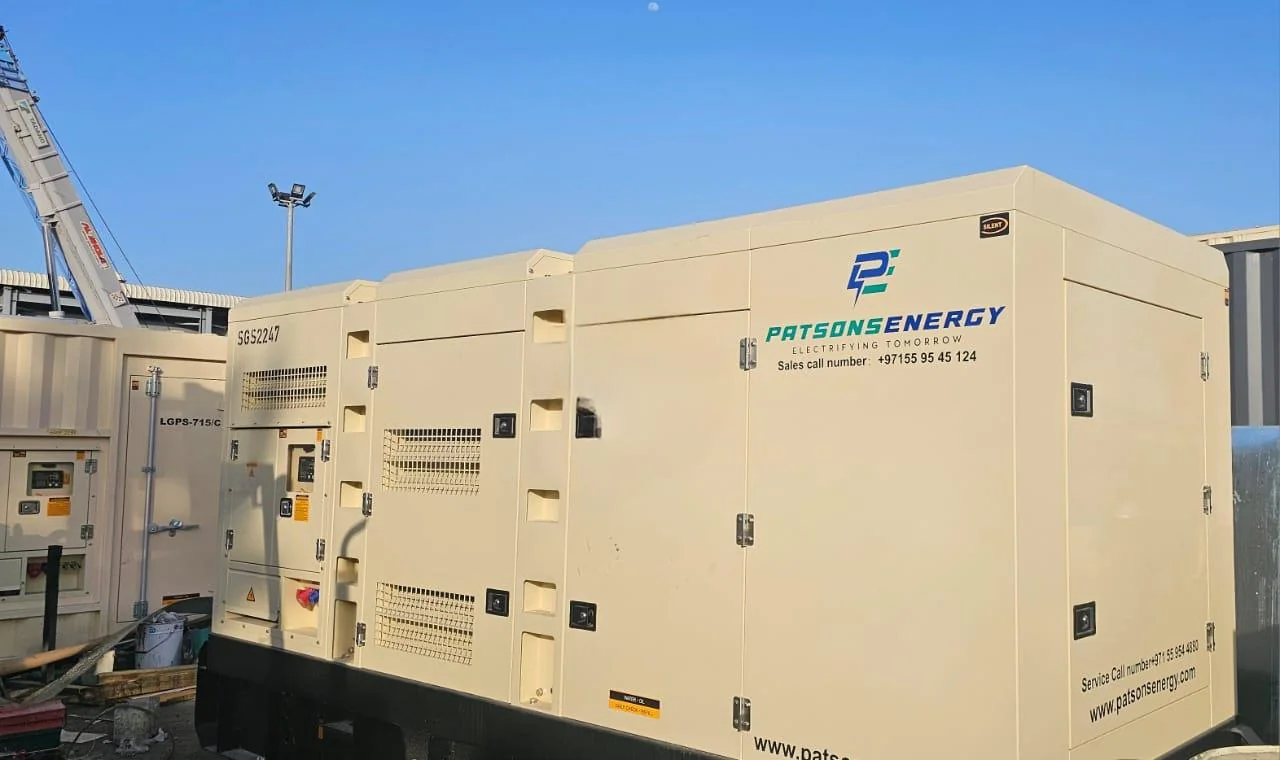
Acoustic power packages
Reduce generator noise without creating cooling or access problems.
We design and manufacture acoustic canopies and custom enclosures around the generator, site conditions and required noise target. Ventilation, exhaust and maintenance access are considered from the start.
System design
Good acoustic design starts with airflow
Every attenuation element adds resistance to the cooling-air path. The enclosure must reduce breakout noise while keeping radiator performance, combustion air, exhaust back pressure and engine-room temperature within the selected equipment limits.
Patsons evaluates the generator layout, intake and discharge arrangement, attenuators, louvers, silencers, door seals and internal lining together. The design is then coordinated with service clearances and the site installation.
The finished arrangement varies with the generator, noise target and installation.
- Project-specific sound-pressure target and measurement distance
- Intake and discharge attenuation with weather protection
- Critical, residential or project-specified exhaust silencing
- Sealed personnel and service-access doors
- Removable panels for major maintenance where required
- Pre-treated steel and coating system selected for the environment
Package formats
From compact canopies to walk-in enclosures
Close-fit canopy
A compact weather and acoustic package for standard generator installations where footprint is tightly controlled.
Walk-in enclosure
Additional internal service space, personnel access and coordinated plant-room-style ventilation.
Drop-over enclosure
A fabricated acoustic structure developed around an installed or skid-mounted generating set.
Containerized package
A transportable system with integrated acoustic, ventilation, exhaust and equipment zones.
ExploreDesign inputs
What we need to quote an acoustic enclosure
Swipe horizontally to view all columns
| Input | Why it matters |
|---|---|
| Generator model and radiator data | Sets dimensions, heat rejection, airflow and allowable restriction. |
| Noise target and measurement point | Defines the attenuation duty and how compliance will be evaluated. |
| Site ambient and recirculation risk | Influences opening sizes, air path and temperature margin. |
| Footprint and access constraints | Controls door positions, removable panels and maintenance strategy. |
| Exhaust route and silencer grade | Affects back pressure, heat management and overall sound performance. |
| Coating and environment | Determines material preparation and protection for the operating location. |
-
Generator model and radiator data
- Why it matters
- Sets dimensions, heat rejection, airflow and allowable restriction.
-
Noise target and measurement point
- Why it matters
- Defines the attenuation duty and how compliance will be evaluated.
-
Site ambient and recirculation risk
- Why it matters
- Influences opening sizes, air path and temperature margin.
-
Footprint and access constraints
- Why it matters
- Controls door positions, removable panels and maintenance strategy.
-
Exhaust route and silencer grade
- Why it matters
- Affects back pressure, heat management and overall sound performance.
-
Coating and environment
- Why it matters
- Determines material preparation and protection for the operating location.
Frequently asked questions
Common questions
Can’t find what you need? Send us your requirement and our team will help.
Can Patsons design to a specific generator noise level?
Yes. Provide the required sound-pressure level, measurement distance, operating load and site conditions. Patsons can then develop the enclosure and silencing concept around that criterion.
Will a soundproof canopy reduce generator output?
A correctly engineered enclosure should keep cooling-air restriction, air temperature and exhaust back pressure within the generator limits. Poor airflow design can cause derating or overheating, which is why the acoustic and thermal design must be coordinated.
Can you manufacture an enclosure for an existing generator?
Potentially. Patsons needs the generator dimensions, radiator and airflow data, service clearances, site layout and noise target before confirming whether a drop-over or custom enclosure is suitable.
Are outdoor acoustic enclosures weather protected?
Outdoor packages can include weather louvers, sealed access doors, protected control interfaces, drainage details and a coating system selected for the environment.